Wednesday, July 11, 2012

Back on track

A July thunderstorm approaches...
...trying to get a sense of the summer panorama out in the prairie. The white flowers are yarrow (and some phacelia and wild buckwheat) and the pink are clarkia...Gallardia, cinquefoil, Rocky Mtn. little sunflowers, and lupines are also blooming, but it is an odd thing about photographs that you can see these things when you are standing there, but it is hard to see them if you can see them at all in a photo.
I finished my never-ending CD project this week, and I'll post a track or two on my website eventually. It was a lot of fun to lose myself in country music for half a year, and I learned a lot, too. I hope Shiloh has a great success with her recording, but I am so very pleased that I get to return to my own projects at last!

Thursday, June 14, 2012

A sonic signature

Gracie and lupines, 6/14/12

I am at last mixing the project that has had me sidetracked this Spring.  In the middle of mixing one of the songs today, I had soloed my piano and fiddle parts right at the end, and it just sounded like this place and its music somehow, like a logo for palouserivermusic ought to sound.  Russ Rosenbalm played a lovely cymbal wash at the end too, and so I put that in there.  In the actual mix you will probably barely hear it... Here it is.

Thursday, May 17, 2012

Spring 2012

Delphinium nuttallianium, about a week ago

I didn't plant this patch of upland larkspur in the far southwest corner of the property.  I have carefully worked in Idaho fescue around what was 1 or 2 plants for years, praying that I could get them to spread.  All of a sudden this year, about thirty showed up!  They are difficult to get going.  The only patch I have been able to establish myself from seed is in the otherwise-disturbed southeast corner (a former cow manure dumping site decades ago, I was told). 

Camas is blooming!

It just really opened up in the last day or so, and it looks like there will be a nice drift throughout the middle of the property.  As with much actual news in the prairie, the most interesting thing to me is barely visible in green--hundreds of new camas plants, apparently coming from seed, everywhere.  I put a 1/2 pound of seed out maybe five years ago, and I planted a lot of locally-collected camas seed last year, so I'm not sure which planting has arrived.  Anyway, it is inspiring to see that the camas part of the project is essentially finished; in another few years when these are all blooming, there should be a nice blue pond every May.

"Standard view"

I came up with this view years ago, before I knew how this was all going to come out, and I think I have to show it for comparison, but most of the excitement is closer to the house.  In the sense that the news there is invisible because it's green, it is showing lots of promise.  There is another blue elderberry on the right, a syringa, and a snowberry.  Significant shrubs in the future.  The Idaho fescue is mature and filling in very well, and there are few weeds.  The intense cover of epilobium from the previous two years seems to have toned down and clarkia is coming back vigorously.

Lomatium triternatum in bloom

So, if I do walk towards the house, I come upon a scattering of nine-leafed lomatium.  These are spreading throughout the northern part of the property, and are interspersed with the camas too, as they are in several of the surviving camas patches around here.     

Saturday, April 7, 2012

Hope

Idaho blue-eyed grass (Sisyrhincium idahoense) blooming in the prairie, 4/7/12.

About a year ago I made a post about voles and how they had destroyed the first bit of real prairie I had created. There were tunnels and tunnels and nothing came up and it was all pretty bleak. The theory I had then was that maybe they also helped spread the plants that they consumed, and I decided I would wait until the next year to see what happened in that spot.

I am an optimist, and I do think that regular everyday life reveals mysteries and what would be miracles except these things are not extraordinary. It's just what happens. And so it was with these prairie spots. Yeah, the voles went insane (and then mysteriously went away...until they inevitably will return in a few years), but as I suspected, they did indeed spread plants around. All through this area now are stalks of sisyrhincium (Idaho blue-eyed grass), and many of the grass-like hairs that will become full-blown sisyrhincium in the future. I spotted two fritillaria pudica coming up, too.

We have had too much snow, but it is a fine thing to see Spring poking through!

Friday, March 23, 2012

Stereo Banjo

Recording setup for stereo banjo, 3/22/12

When I recorded my banjo back in the 1980's, I always went with whatever the engineer or producer had in mind, which was the standard approach, putting the microphone out front. As I learned more about recording and paid attention to how a banjo sounds, I started notice that the richest sound came out of the back. This is why I prefer the open-back banjo sound, and put the soundhole of my gourd banjo facing me (earlier posts...). So, when I went back to recording the banjo in the last few years, I wanted to try to record the back, which did indeed sound much richer, and from there I got the bright idea to put two small-diaphragm condenser mics (here, two Neumann KM184s) in the configuration you see above, one in front and one behind, panned into a fairly-wide stereo. The first time I tried it in an official session was on Paul Ander's banjo on this track of the Steptoe project. Both his banjo and mine above have a rag stuffed in them, too. I love this stereo banjo sound, how it is somehow three-dimensional in the mix without being in the way of anything else. Now that I think of it, the Steptoe project wasn't the first time; I used it on my great-grandfather's 1893 Fairbanks banjo when I recorded Lullaby on Handmade. There it is in the background, but it has that same 3-D effect.

The banjo here is a c.1918 Bacon Blue Ribbon (it has the proto-flathead tone ring of the later Bacon & Day banjos and a weird detachable cover for the back that anticipates their later resonators, which I just leave off), with a neck I made for it in 1985, and a real skin head. Recording Shiloh's CD gives me a few opportunities for trying my banjo sound out on a new audience.

Thursday, March 15, 2012

Sidetracked

Russ Rosenbalm's drums, ready for recording, 1/25/12

So, I was right on the cusp. A couple of parts to score and record in my musical recording project. Ready to start recording with the new gourd banjo. Then, I disappeared!

Dona saw it coming, when we scheduled Russ to come down to record, she said, "Could you finish that shelf in the bedroom, maybe..?" Too late. But I had points for finishing her room from last year (earlier post), so I'm OK.

I have had several of these interventions in my long-term plan, which explains a lot, but they have always been great projects to do, and this one was now or never. Shiloh Sharrard is a local (Moscow, ID) singer, who I first heard when she was 11 (and was already a great country singer...), and later recorded when she was almost 15. She is really good. Now it's four years later and she and her dad are going to Nashville, and they need a new CD for a thousand reasons, but this meant a whole production from the ground up. I knew a great drummer who had just moved to Spokane. How could I not do this?

Anyway, this kind of thing takes over your life. Another month, I'll be making the shelf.

Thursday, January 12, 2012

Epilogue

I rarely finish anything cleanly; there is always some sort of edit involved. On the gourd banjo I had to make a new nut, and tweak a few other things over the last month or so. After a few weeks of playing I started to crave some sort of position markers when I realized that flying up for what would be a 12th-fret or 17th-fret note was never going to be anything other than a gamble if I didn't get a visual cue. So, I added little rosewood position dots today.

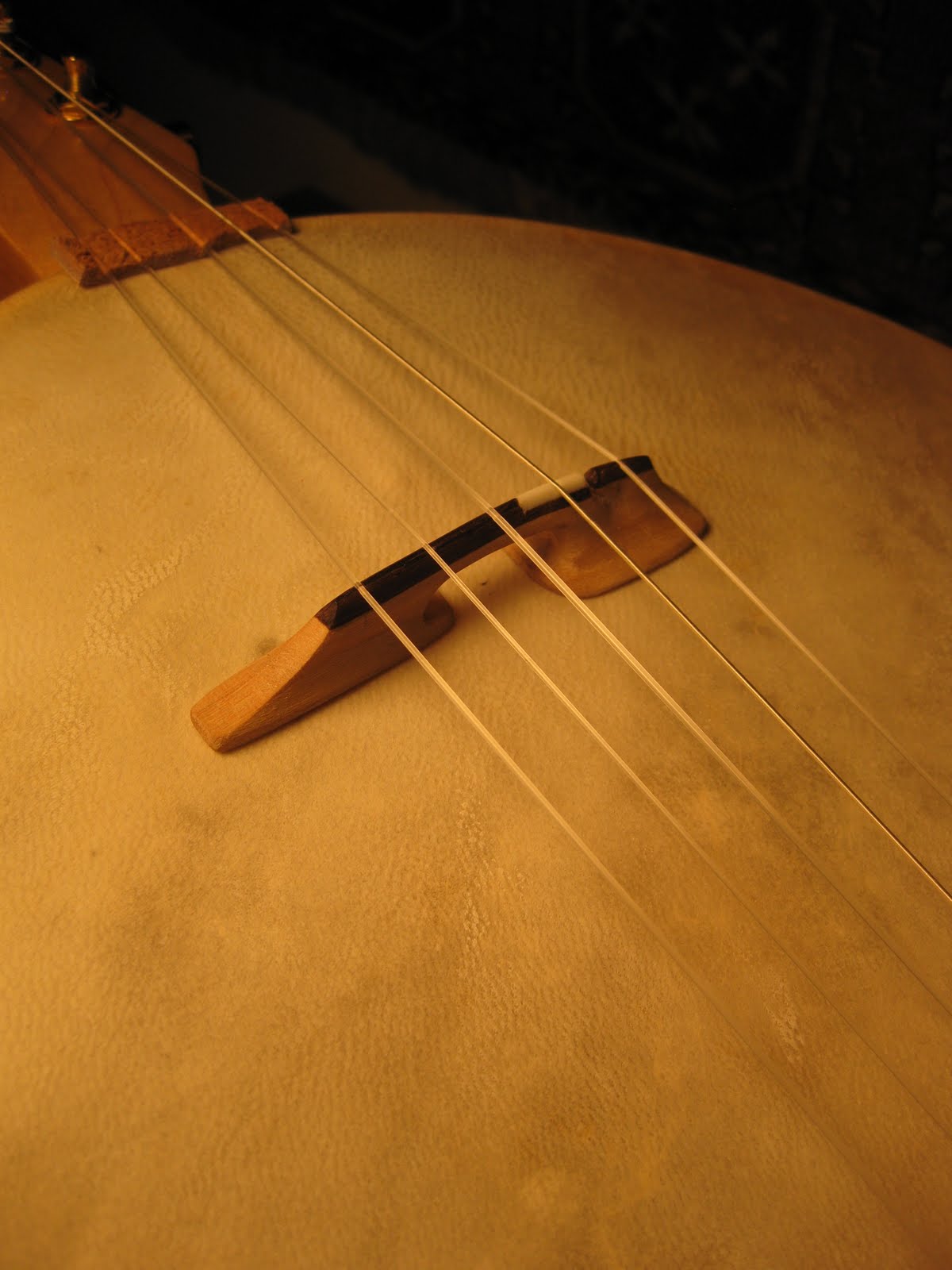
This is the current bridge design. There is a rosewood cap, with a break between the 4th and 5th strings, and a bone inlay for the 4th string. There is a bit of inspiration from the work of physicist Michael Kasha with guitar design in the difference in the two feet, the top one meant to spread the bass frequencies and the bottom one to focus the treble. I think the brace (see previous posts) acts like a fulcrum for the movement of the two different feet. I may separate out the foot of the 5th string from the bass foot and lighten the treble foot somewhat...we'll see...

This is such a lovely instrument to get to know. Much more of a voice comes out of this than any banjo I have heard. I'm starting to get comfortable with it.