Friday, June 5, 2015

The natives are restless

Needle-leaved navarretia (Navarretia intertexta), blooming this afternoon.

I have been clobbered by an evil stomach bug that has lingered now for four days, but I finally felt up for a little walk, and I wanted to check on a patch of small white flowers on sort of spiny stalks, just a couple of inches tall at most.  They've shown up elsewhere, and when these sweet furry green things became sorta sharp brown things, I assumed they must be evil.

When I saw them again this year in a spot in the second-year prairie, I had recognized that native annuals (like the previously-mentioned Midget phlox) were showing up in this area.  I thought that I had better identify everything, so I can walk through in the next week and pull the stray Prickly lettuce and mustard (thankfully, there is much less of this as the years go by).  They do have sweet tiny flowers, and before they become little sticker things, they make a lovely little patch like this...


And, sure enough, consulting my Wildflowers of the Pacific Northwest (Turner and Gustafson), there it is on p. 161.  It looks like it will provide some needed competition to all of that Epilobium you can see sprouting around it.  We'll see how this goes, but my theory is that these annuals fill in and provide cover for the perennials that are coming up everywhere.  There's actually quite a bit of native grass species throughout, but they are still only little green threads.  After the perennials mature, these annuals remain ready to take advantage of any opportunity.  Now they're getting an unusual opportunity and I hope they behave themselves, but I think it is just this sort of biomass that creates an actual prairie as it composts.   

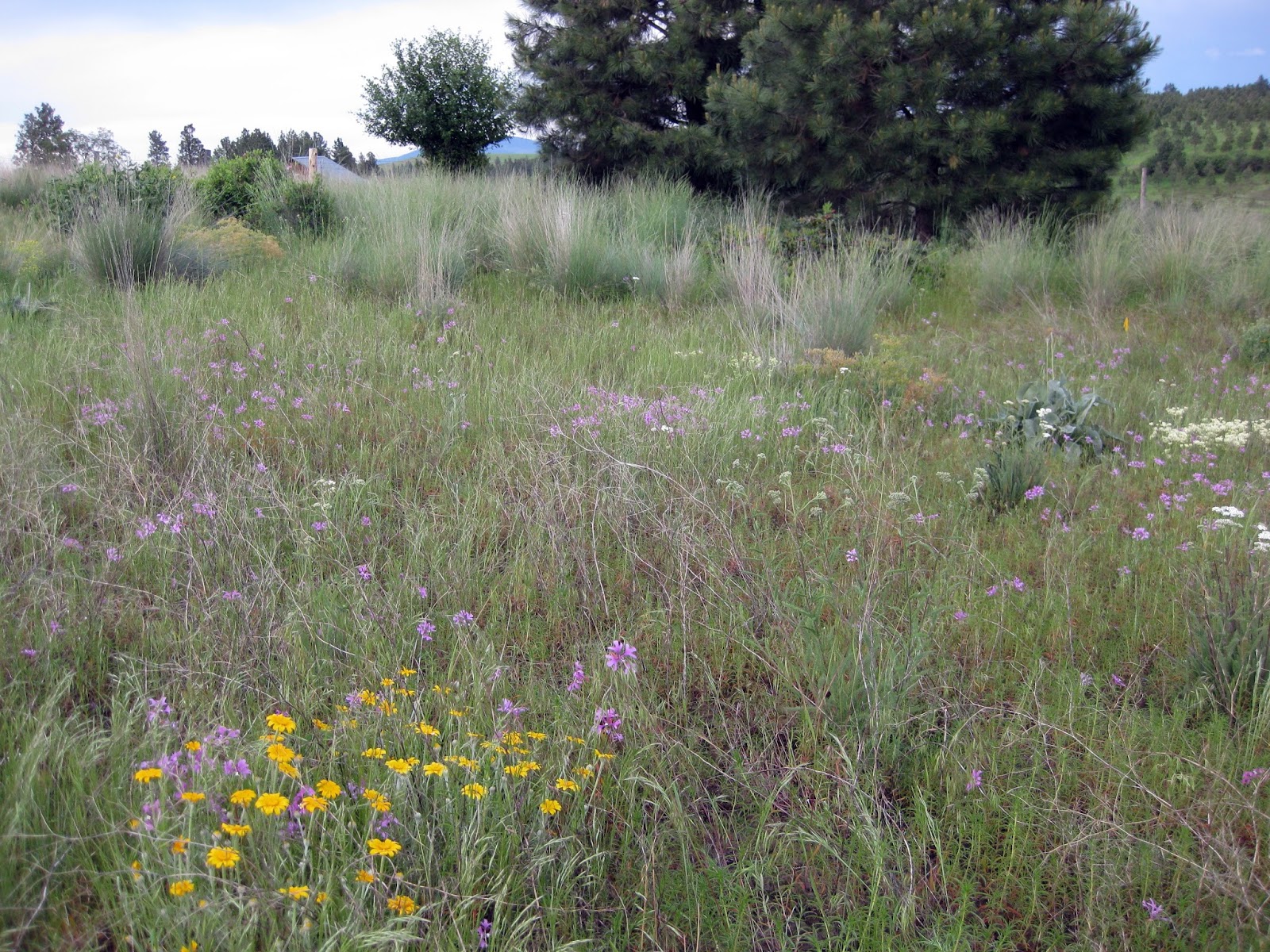
And here's a shot of clarkia and Oregon sunshine in all its glory as I walked back to the house...

Monday, June 1, 2015

Late Spring bloom...

Oregon sunshine, clarkia, Wyeth buckwheat, and yarrow blooming in the prairie today...

These images are all from my "second-year" prairie, the areas that I planted 18 months ago with the Palouse Conservation District grant.  There are some plants in this area that have been here for awhile--the Arrowleaf balsamroot (past blooming now, but you can see the large leaves on the right side of the photo) is fifteen years old--but most of this area was replanted with natives when I received the PCD grant.  This area is where I took the previous post's images of Midget phlox, which I didn't plant, but it was somehow inspired to show up here.  It is still blooming, but you can't really see it in this image--they really are tiny flowers.

One of the great successes of the PCD replanting was Taper-leaved penstemon (below), which I think is spectacularly beautiful.  This one blooming here was planted as a plant in a pot (from the Idaho Native Plant Society sale last year), but I also purchased a bunch of seed and there are many, many penstemon sprouts all over the place on the property now.  I am really looking forward to seeing drifts of this fabulous flower in the future!


One of the plants that I planted in this area years ago was this Gaillardia aristata, which has now grown into a substantial clump.  This is a plant that you can buy in a lot of nurseries--supposedly it is the same species--but the cultivar generally has redder petals.  I think the local native version is more beautiful.  The seeds for this one came from a population that grows a mile east of here.


I have to go through this entire area to pull seed heads off of cheatgrass and other annual grass species, but it is basically finished, as far as substantial planting is concerned... 

Friday, May 15, 2015

A gift


Midget phlox (Phlox gracilis), blooming in the prairie...

I have seen these tiny annual flowers in the middle of our property for years, pretty little pink flowers, mostly, though there are white ones, too...


They are the sort of tiny plants you can see all over native Palouse prairie remnants, but not in the more cultivated parts of my prairie restoration effort.  Until yesterday, I had not identified them, but they seemed so delicate and sweet that I assumed they must be native.  I pulled out my handy field guide last night, and there they were--I wouldn't have guessed that they were phlox of some kind.  Along with another annual, Blue-eyed Mary, which I have written about previously, I have been able to save them from my weed control efforts and it is an inspiration to see them coming back in the second-year prairie.  They are plentiful enough that I hope they spread their seeds throughout the property...Though you can't buy these sorts of plants from any supplier, I suspect their role in the prairie ecosystem is important, since they fill in and keep invasive species out, and they appear to react with the soil, making it more receptive to other native plants.  It seems like such a gift for Nature to plant them for me!

It has been awhile since I posted a shot of the five-year-old prairie restoration area in the northern part of the property.  Not much blooming there that you can see at the moment (the Midget phlox turns up south of this view), but it is healthy and thriving...There are actually quite a lot of nine-leaf lomatium there and other good things, but they get lost amongst all that Idaho fescue.


Tuesday, April 7, 2015

Back in business!


I just finished making a little wooden pad for the laptop so it can stay cool sitting on that nice antique South Persian mat (Khamseh Federation, late 19th c.).  After nearly two months (!), Palouse River Music is back to recording.  I hope it's another thirteen years before I have to go through all of that again!

Sunday, March 29, 2015

Spring


When the grass widows are blooming, it's Spring.  For signs of excitement in the prairie, though, it's best to go to spots like this that have been established for a few years.  The areas I planted last fall are still pretty bleak (below). 


 In areas I planted in fall of 2013, there's more activity...


Close up, this second-year growth looks like what you might expect in the first year at this point, but a prairie unfolds at a very slow pace...Below, the wide-bladed leaves are Western groundsel, and the five-bladed leaf to the right is an Upland larkspur.  I hardly saw any larkspur last year, but in those areas now are numerous drifts of it.  It just takes this long to get going, and may not bloom until next year or the year after.


For comparison with images I've shot of this area in previous years, this is what a planting looks like in the second year.  Patience, patience...


Tuesday, March 17, 2015

Karma

It was not even a month after I had bragged in the previous post about how I had nursed my c.2002 computer and recording system past their planned obsolescences, and saved thousands by doing so at no loss of quality.  Had my backup G4s...oh yeah...

First the main hard drive failed in the computer.  Dead.  The backup G4 was a "great machine" (words of the excellent Mac service guy at our local Moscow, ID dealer, VGH--good people...), but ultimately it had been made a year too late to work the version of ProTools I had.  Just like that, my system was toast.  Except that this realization took about two weeks.  At least I'm backed up, and they say that I will be able to open my version 5.3 files in...version 11.3 (!)  But a new computer meant that I could no longer use my perfectly wonderful fancy audio interface because current ProTools doesn't support the old interface.  They had me.

I was surprised how vulnerable I felt when I realized that my last 13 years of work clings to electrons in a backup and back-backup drive here, and until a few days ago, I actually wasn't sure that my files would open.  I've spent some time thinking about what I could recall if I had to.     

Above, work has stopped this morning while I wait to hear back from my helpful "sales engineer" for why the HD PCIe card doesn't quite fit into the slot designated for it in the Sonnet chassis, so I can thunderbolt that bad boy into the HDX interface.  Why don't these things ever go "click, click, click--GREAT!--Back to work!"?

So it's Irish fiddling until I hear from the guy.  


Saturday, January 24, 2015

Vintage Pro Tools

My workspace, this evening...

This Pro Tools "rig" was put together in 2002 and is the guts of my recording studio.  This is Pro Tools version 5.3.1 (currently, the official Pro Tools is version 11.3 about to go to 12), running on a Mac G4 using Mac OS 9.2.  I'm using the fancy "HD1" D/A interface that was the hot new thing in 2002; it was so new that my dealer was required to sell me the old version and then fall all over himself apologizing that he couldn't offer me the new HD1 because he had to be silent about its existence, and then he changed everything out and his diligent complaints to the company got me a "free" $1K reverb program along with the new cutting-edge high-definition digital recording setup.

Soon after I had this system up and running, Apple released OSX, and everyone I knew was hot for the new software upgrade.  Some little voice inside me said don't do it!  So, I didn't upgrade.  OS 9.2 was so stable.  Everything finally worked together perfectly.  I had just gotten to the point where I had unlimited top-of-the-line professional-quality audiophile multitrack recording time.  I think it would be hard for any professional musician who was making music in 2000 not to appreciate the creative power that was made available by Pro Tools HD on a Mac G4 running OS 9.2.  It was a major technological revolution.  I had a Waves bundle, I had Reverb One...why would I want to change anything?!  I had work to do! 

So, from that point on, I never upgraded and I've been making records and doing projects ever since.

Had I gone to OSX, the first thing that would have happened was that my "Waves Bundle" would have ceased to function.  Doesn't sound like much, does it... but it has all the functions--plug-ins--that make a recording device into a studio.  Compressors of various sorts that can bring out he musical sound quality of a recording, equalizers that are endlessly-adjustable tone controls for any recording--for example, you can easily take out a nasal sound that you hear close to a singer's face, but you don't hear ten feet away.  Anyway, I never calculated the exact figure, but I think the immediate cost to me would have been something like $5K.

In 2012, in the midst of a CD project, I had two interesting disasters that alerted me to my peculiar technological situation.  First, one day I went in the studio to do some editing of the previous night's session (fortunately I had backed it up), and my computer completely died.  Not just the "mother board" had died, but the MOTHER of all motherboards, the "logic control board" had died.  I was a bit panicky.  But I took the computer into the local Mac repair place, and the guys had an old G4 sitting right there--I bought that computer and they had everything transferred in a couple of hours, and I was back out the door and better than ever for $250.  Right away I jumped on eBay and bought another G4 for $150 just to keep in the closet ready to go.  It does seem amazing that you can buy a computer that cost over $2K in 2002 for $150 ten years later.

Then one day a few weeks later I went to work and all of a sudden I get an error message from the fancy "Reverb One" program, saying that "the date on this computer is incompatible with the operation of this software."  Hunh?!  So, I changed the date on my computer to the previous day and everything worked.  Yep, the designers of Reverb One had determined that surely no one would be using this software ten years after they released it, so from there on, my computer has always been in January of 2012.  In the image above, there's a little sheet of paper to the left of the keyboard that lists the first week of 2012, so that I can periodically switch the date back and match the day of the week.

So, on the phone last week with Mark, my helpful Sweetwater Pro Gear customer representative, I determined that my suspicion was correct, that while the current Pro Tools is "faster," there's a lot more "processing power," in fact, the sound quality is not any better.  And if I decided to upgrade, my set up is so old that while I'd get a certain amount of trade-in value for my old HD1 converter, essentially I would have to start over with everything.  New computer, new interface, all new software...Something like $15K.  More expensive than it was in '02.  I can buy A LOT of used Mac G4s on eBay for $15K...

Score one for the Luddites...