Friday, April 25, 2014

April in the Prairie

Prairie, looking southeast, 4/22/14

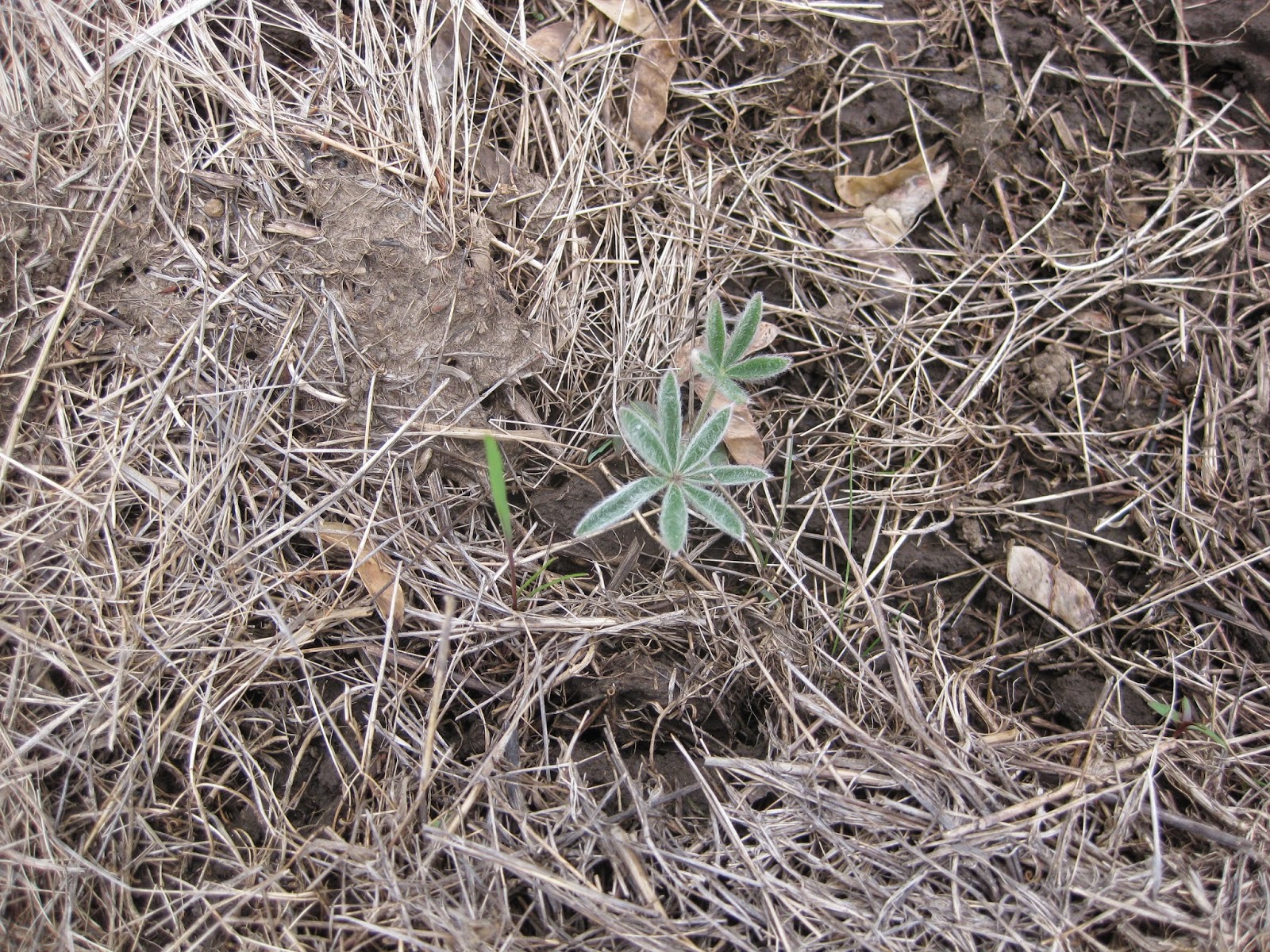
The new project in the south is encouragingly free of weeds and sprouting all sorts of promise.  The method suggested to me by the folks at the Palouse Conservation District and Thorn Creek Seeds (Jacie Jensen) appears to be the way to go (see posts last fall).  In short, you clear an area, and then rake back to expose dirt and plant the seeds on that.  Here is a little Silky lupine and a Lomatium ambiguum sprout from in among those pine trees...


I have been surprised in this area by several patches of Lomatium ambiguum that I didn't plant, as well as a patch of Upland larkspur that I didn't plant.  Today I spotted a larkspur bud there, just about to open...


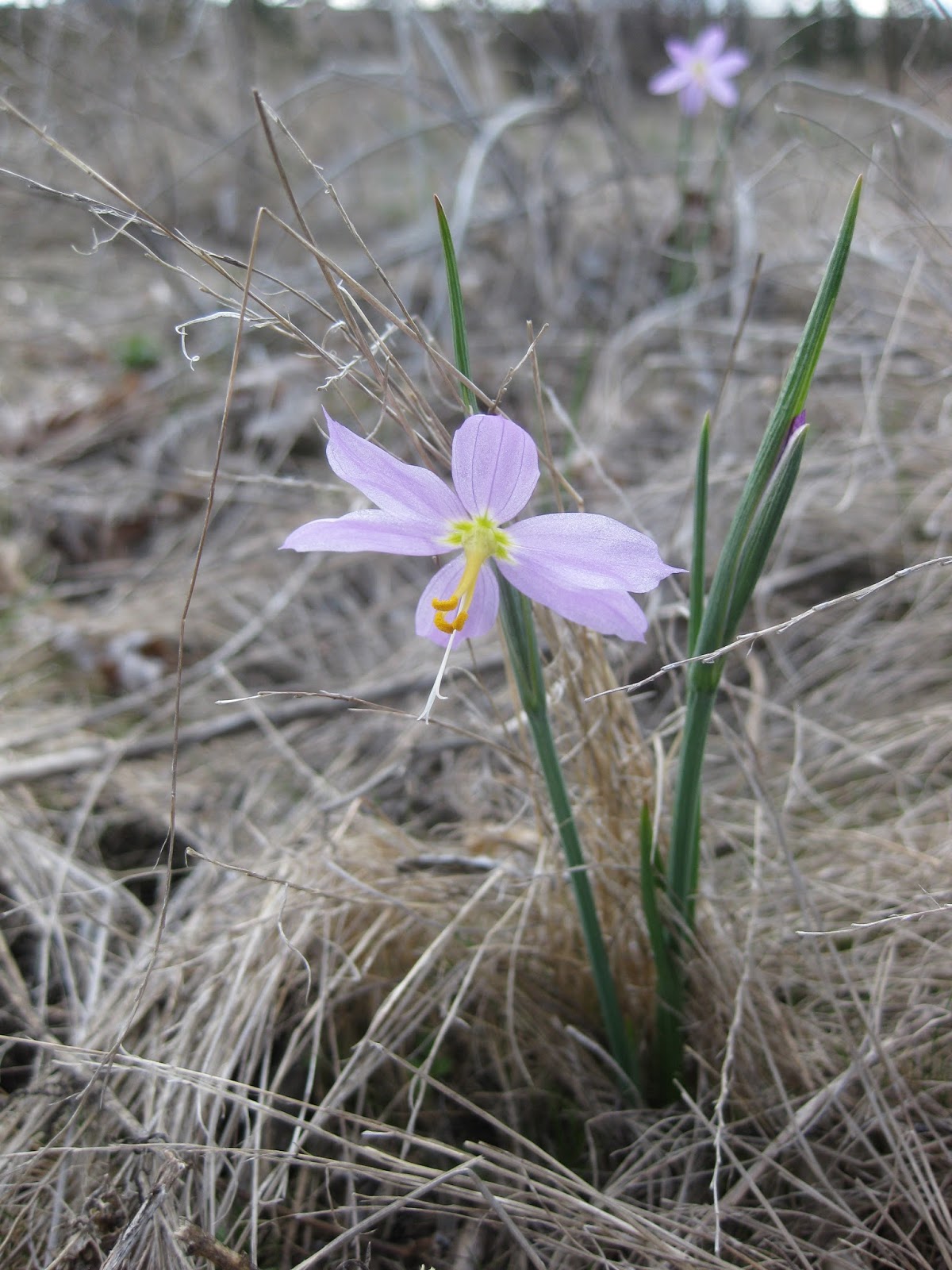
I think the most stunning bloom at the moment, though, is from a clump of Red besseya.  The biggest clump was chomped by the evil deer (they chomp, but the plant is fine really), but this one escaped their onslaught.


It has been awhile since I have posted a shot from my standard view.  Here is how it looked this afternoon.  Spring!


Thursday, April 3, 2014

Drainage Ditch Delphinium

Newly-transplanted Delphinium nuttallianum

An often-repeated rule of native plant enthusiasm is that transplanting is not a good idea, for good reason.  The reason for this is at least two-fold, that digging in a native plant location damages the environment and that dug-up native plants rarely survive anyway.  There is an exception to this rule, and that is if the plants are threatened and likely to be destroyed.  Then it's rescue.

There are several locations I keep an eye on, because there is pristine Palouse prairie coming right up to the road, with a bank and a gravel ditch between them.  Because the county drives these gravel back roads every year in tanker trucks, spraying these banks and ditches with herbicide, native plants in the drainage ditches are fair game for rescue, since they will soon be dead anyway.  They will spray again in another month or so.  Last year one particular spot had a sudden arrival of many, many Upland larkspur (Deliphinium nuttallianum), seeded from the prairie above.  Because I knew they were toast, I dug four clumps out of the gravel (because of the gravel, their roots were easy to extricate) to see if this would even work, and three out of four of them returned this year.  Possibly, the fact that I am only moving these plants about a mile means that the change in conditions is not that dramatic.  Nevertheless, the success of this project sent me back there today, and sure enough, there was another blanket of Upland larkspur in the gravel.  This time I got five clumps.  Ever hopeful.   

Thursday, March 27, 2014

Spring!

Idaho blue-eyed grass, blooming in the prairie yesterday...

A lot of the excitement for me out in the prairie at the moment is not as showy as these lovely little native flowers, but there are shoots of all sorts of stuff coming up.  Clumps of larkspur I dug from the gravel of a drainage ditch last Spring appear to have survived, and Brodiaea douglasii is coming back with a vengeance...


You can't see much unless you look closely--click on the image to see it larger--but there are hundreds of little green sprouts here.  Each one is a Douglas hyacinth (aka "Brodiaea douglasii") that come up from a very deep bulb (I have never been able to move them, just encourage them to move north from the fencerow).  For years they are just a plain green shoot, but then they put on their show, which is pretty spectacular.  Similarly, in an area previously devastated by voles, the Sisyrinchium (aka, "Idaho blue-eyed grass") has spread itself and is well on its way to being a "drift."  All the green shoots you see below are Sisyrinchium.  These areas have so much exposed dirt because the dead annual grass from last year was raked off last fall.  A lot of seed is on there as well, but in the first year, it doesn't usually show until later.


The expanse of brown makes me seem like an unrealistic optimist, I suppose, but I see a lot of promise out there.

Saturday, February 8, 2014

Violin tasting, part II

Violin by Magnus Anton Fichtl, Krems an der Donau (near Vienna), c.1775-85

My last violin tasting was in November of 2012.  It has been a wild ride since then.  I think this is my equivalent of a mid-life crisis, but not with my people, but my violin.  I had been married for 30 years to that 1840 C. F. Hartmann, and she was not an easy partner, but you work with what you have, right? [If you are coming to this later in this story, you can go to those 2012 posts and see what I'm talking about]  I've tried writing about some of this, but it's a little difficult--one transaction involved absolutely dishonest sleazy behavior on the part of a well-known individual, another involved some sort of issue between two dealers that I don't fully understand, but I think one bought a violin out from under the other who had thought the violin deserved a more respectable price and didn't approve of the quality of the transaction.  I'm in there just trying to get a decent violin with some soul, and I suspect that detailing either of those transactions could get me sued if I filled in the blanks.  Anyway, there are four violins in the story before I got to the Fichtl.

The end result is that I am now the proud owner of this magnificent Viennese violin, shown above.  I had never played a really good violin for any length of time.  I had ten minutes each with a late Stradivari (1730s) and a Stainer thirty years ago.  The Strad was weird--I could tell that there was some intensely lovely sound happening 15 feet away from me, but there was no intimacy whatsoever with that violin.  I understand why a modern classical player would love this sound, but I find that sound entirely too extreme.  The Stainer was exquisite, jewel-like in the treble, rich in the bass.  I wanted that violin, but I believe that I am on the path to that sound with this Fichtl.  It hadn't been played for 16 years when I got it, though it had been restored in the interim (I am told).  The first five minutes was disturbing--it was NASTY!  But, she is 240 years old and had been asleep for 16 years!  After an hour, there was this intriguing softening...Each time I played it, that softening moment occurred earlier and earlier...A luscious singing tone started coming out by the third day...It is still changing, even now...

After a week I took it to my friendly neighborhood luthier, and Paul Hill found a mellower spot for the soundpost, but he wouldn't cut a new bridge until I'd played it for another couple of weeks; he said that the tone was still too much in flux.  I wanted to show some of the subtle differences between the last three violins that are here, so I made a YouTube video yesterday.  Neither of these is unpleasant.  There is a little distortion in the computer mic on the third violin, but I urge you to ignore that--maybe that violin is a little louder or that was some weird fluke.  I am not at all sure this method delivers these violins all that accurately--the sound in the Fichtl appears all around me in a sheen that probably doesn't quite make it into the computer mic, the old c.1800 Saxon that started this adventure is as mellow and smooth as it seems here; though the sound is muted compared to the Fichtl, I still like it.  The mid-19th c. Saxon has a bite that the earlier Saxon doesn't have, but it doesn't have the chocolate-y richness either.  3/4/14 update--I added a clip on the end of this video demonstrating the Fichtl violin with the new strings and setup by Paul Hill, which turned out to be a pretty dramatic transformation.  I thought that would be an interesting comparison, to hear the effect of a great setup.  Anyway, here is a link to the video...

So, if you had been in the room, there would be this hard-to-describe effect of the Fichtl.  It has a whole level of sound that is just not there with the others, even before it received its final bridge and string setup.  After the setup...well, it's sounding pretty ideal to my ears...  I wish there were some kind of advice I could distill from my year-plus violin search, other than--cultivate a connection with an expert who can advise you when an awesome violin comes up on...eBay(!?!)...and says--you must buy this violin.  Another very knowledgeable expert told me--"With violins, you just can't expect to get a screaming deal--there are too many people out there who know more than you do, and you will end up with something with problems if you try to get a treasure for less than a retail price from a reputable dealer."  I can just say that, after some of the pits-of-despair that this violin search has taken me to, it is a profound relief to say that I will never have to go violin shopping again.

Wednesday, December 18, 2013

Camas in December


Camas actually blooms in May, but I just installed this window I designed almost a year ago.  The prairie is put to rest for the winter and though music is going on as always, there is nothing to write about in that vein at the moment, but the prairie still blooms in our front door.


Here is what camas looks like, and I tried to create an abstract suggestion of it in stained glass.  The window was made by Darcy Lodge at The Stained Glass Co. in Lewiston, ID. and I think she did a great job.  I started with a drawing last February...


Then it look far longer than anyone anticipated to get this made because there was an odd bit of glass Darcy was trying to use for the camas leaves, and she'd get it all together and then it would crack and she'd have to take the window apart and replace the cracked piece.  Finally, though, late last month she had it done, and we had it laminated with glass.  I am so accustomed to having things not quite fit in this old house remodeling project I've been working on for more than 20 years that I was shocked to find that not only did this slip perfectly into the window opening, but somehow the sandwich of glass, stained glass, and glass was exactly the same thickness as the window opening.  Every once in awhile Murphy's Law doesn't apply, which is a good thing in this weather--no one wants a wide-open hole in their door in winter this far north!

Sunday, November 10, 2013

In the studio and the prairie...


I went back to work on the CD of my gourd banjo music last week, and this time got a good recording of my arrangement of Isaac Albéniz's (1860-1909) famous piano piece, "Asturias (Leyenda)," played in stroke/clawhammer style.  You can listen to it on the "Music" page of my website.  Of course, it is more famous as a guitar piece; I think the most famous classical guitar transcription is by Andrés Segovia, and it is one of the standards of classical guitar repertoire.  I had worked it out c. 1985, but when I stopped playing the banjo in the late 80s, I let it slide with the rest of that repertoire.  I never recorded it.

I don't think the banjo needs to play classical European music; really it is built for an entirely different expression, and a lot of the pieces I worked out in the old days were easy to let go, but a few of them stuck with me, haunting me a little bit--I loved playing some of that music.  When I started playing this new gourd banjo, everything sounded different, and when I played through the bits of "Leyenda" and "Les Barricades Mystérieuses" I remembered, they sounded so gorgeous that I wanted to resurrect them, so I did.  I love playing them, and that's good enough for me.  I have also recorded the Vivaldi Lute Concerto in D that's on my first LP, but I'm playing a different part now.  I worked out the orchestral/continuo part on the gourd banjo, and Richard Kriehn plays the solo part on mandolin.  Again, it sounds so cool--how I could I not record this?!  So, in addition to the Gottschalk pieces (yeah, I've recorded two of them), I will be putting Vivaldi, Couperin, and Albéniz on this upcoming CD.  But I really am not a classical banjo player, whatever that would mean.  I just love playing those pieces.

In other news, it is planting season in the prairie.  After a demoralizing couple of hours yesterday, I have had to revise the plan somewhat.  I am not able to rake the entire 1.5 acres I had planned on raking.  There are areas where evil grass and storksbill, etc, are dying and dead, but the fibers of the plants are still in the soil and raking them out will kill me.  I have resolved to continue watching those areas and let the old grass and weeds decompose this winter and next year, and I will have a much easier time in those areas next fall.

There are, however, several areas--about six or seven--that were like that last year, and now this year it really is possible to rake out that dead stuff (it's still hard work, but...) and reveal lovely soil, clear of weeds.  I've decided to take them on, one at a time, rake them out (Dona helped me today--thanks, darlin'), plant them (native plant seeds generally just get sprinkled on the soil), and rake the dead stuff back over as a mulch.  This is different than the divot method I have used in the past, but divots seem to work only with a few species, and I want to try this method of raking out whole areas.  It was what the Palouse Conservation District people and Jacie Jensen of Thorn Creek Native Seeds recommend, so that's what I'm doing this year.  Here is the first area after Dona and I had raked it out today.


Then I planted...Blue-eyed Mary, Clarkia, Sticky geranium, Lomatium ambiguum, Silky lupine, Indian paintbrush with Idaho fescue seeds, Upland larkspur, and Fritillaria pudica.  A few handfuls of my BFI custom native grass seed mix lightly scattered around too--I don't want too much grass added to this area.  I just sprinkled them on the dirt, and then raked back the dead grass, making sure I put a light cover on everything.  We shall see...

Friday, October 4, 2013

The work begins...


I've gone back to work on my gourd banjo recording, just having finished a nice version of my "back-engineered" arrangement of Gottschalk's "Bamboula."  Of course, I've also dived headlong into the grant-supported phase of my prairie restoration.

I've planted all of the plants I purchased thus far, marking each one with a little green flag to keep track of each thing I've added to the project.  The seeds will come later, after I've done a little spraying of weeds and raked the areas where I'm adding seeds.  I took several photos yesterday, showing different views of the southeastern part of the prairie, where most of the intense planting is concentrated, hoping to create a photographic record of the transformation.


In the foreground of the image above is a little green flag marking one of the twenty spots where I planted an Indian paintbrush plant with an Idaho fescue plug and drizzled with a pinch of Idaho fescue seeds.  It sounds like a recipe!  However, Indian paintbrush requires a host plant to survive, and apparently Idaho fescue is a common host around here.  Pat Mason at Pleasant Hill Farm gave me the fescue plugs for the companion planting, and we thought that the drizzled fescue seeds were a good bet too. 


This last image shows the patch of camas bulbs I planted in a wet spot near the southeast corner of the property.  There I put 3-4 bulbs spread out in each hole and marked each hole with a flag.  As you can see, there is some native grass already established, as well as a few other plants and the 23-year-old Ponderosa pines.

I had one interesting problem with five of the plants I purchased from Plants of the Wild in Tekoa, WA., a problem I have run into before...Sometimes people sell a plant as a native, but the variety they are selling is actually more of a cultivated version of the plant.  This often happens around here with Gaillardia aristata, which in addition to being native here is also a popular garden plant.  The version you find in most nurseries has the red of the center of the flower running out to the petals, while the native (at least in this particular area) has the deep rust red center and rich orange-yellow petals.  Fortunately I have gotten that one going from seed I've collected down the road.

In the last few years there have been several businesses started locally that specialize in only plants/seeds collected from this particular area, and I got most of my items from Pleasant Hill Farm in Deary, ID and Thorn Creek Native Seeds in Genesee, ID--both businesses have this philosophy of focusing on local Palouse natives, but Pleasant Hill only had five Roundleaf alumroot (Heuchera cylindrica) plants, so I got five more from Plants of the Wild.  They are an older business, started back in 1979, and sometimes their plants are not the local native varieties.  Here is one of the alumroots I purchased from Pleasant Hill Farm, which look exactly like the ones growing up on Kamiak Butte nearby.


Next is an image of one of the five alumroots I purchased from Plants of the Wild.  This is obviously an entirely different variety!  Fortunately I only purchased five of these, which I put in the northwest part of the prairie where not everything is native. 


 I hope the other plants (native strawberry, camas bulbs, creeping Oregon grape) I purchased from Plants of the Wild are OK--they look fine.  It's frustrating to run into this problem though, making me feel fortunate that businesses like BFI Native Seeds in Moses Lake, WA (where I purchased my native grass seeds), Pleasant Hill Farm, and Thorn Creek Native Seeds exist.  Their products are fabulous.  But doing this sort of thing, one must be vigilant, I guess.