Tuesday, August 19, 2014

August

"Standard view" this morning...

It has been awhile since I took a photo from this vantage point.  Most of the exciting developments are in the southern half of the property, at least with new little flowering plants and whatnot (that I hope survive this dry period of late summer).  Still, this view has changed a lot in the five years since it was planted.  Here it is in August, 2009.


Sunday, June 22, 2014

Spring Seeds

Clockwise from the top--Grass widow (Sisyrhincium douglasii), Upland larkspur (Delphinium nuttallianum), Blue-eyed Mary (Collinsia parviflora), Yellow bells (Fritillaria pudica...and some other mystery bulb seed), Arrowleaf Balsamroot (Balsamorhiza sagittata), Western groundsel (Senecio integerrimus), and Salt-and-pepper (Lomatium gormanii).  Starting clockwise from the Salt-and-pepper, they are listed in the order their seed was collected.

Even though we are pretty far north and it can get cold here, the native flowers start blooming in late winter with Salt-and-pepper in late February.  Several of these plants have been hard to start, and I have wondered whether the standard advice I have received for planting native seeds--planting in fall--doesn't take into account that all of the plants above have their seeds planted by summer in nature.  Could the dry heat and occasional rains of summer play an important role in their germination?  I decided this year to plant everything I collected before the Summer solstice in the first week of summer.  I have chosen areas that have nothing but native grass, so I can see if this gets better results than waiting until fall.  Let's do science!

Sunday, June 15, 2014

Full Bloom

I was walking out through the prairie in late afternoon today, and was struck by this view--it actually looks like a mature prairie out there!  Years of hard work are starting to pay off...

Thursday, June 5, 2014

Late Spring

 
Looking south--Clarkia, Wyeth buckwheat, and yarrow, blooming in the "new" prairie

There are many small plants just sprouted here that are invisible.  A great deal of taperleaf penstemon is coming up throughout these new plantings, for example.  Still, it is nice to have some reward in the first Spring of a new planting.

In banjo news, I have been experimenting with my gourd banjos.  First, I finished "Gourd Banjo #3" which was the rebuilt version of my first gourd banjo. 


It doesn't have the big sound of #2, but it is a sweet and probably more authentic sound--I suspect that the weight of the metal guitar tuners on #2 somehow anchors the neck so that it doesn't absorb as much energy from the body.  I noticed two things about #3 that I liked right away.  The first is that I really dug out a scoop between the body and the fingerboard and I loved having all that room to work my right hand.  The second thing was that the strings were higher, which should make it harder to play, but nylgut strings are not hard to push down, and the increased string angle seemed to give me a crisper attack. 


So, I realized that I had to alter those two aspects of my beloved #2 gourd banjo.  Today, I opened up more of a scoop (previously, the fingerboard went right up to about half an inch before the body--there really wasn't a scoop) and made a new bridge that raised the strings 2 mm.  Instantly, I had a crisper attack as with banjo #3, and the higher action was somehow easier to play.  That is a bit of a mystery to me, since I had understood that generally with plucked string instruments, you want as low an action as you can get without strings buzzing, but there is no doubt that this higher action is the way to go.  Though I wasn't buzzing before, I may have been bottoming out the strings on the playing surface when I hit it hard, which would certainly be a tone killer.  Anyway, the tone is cleaner and I find that I am more precise with this setup.  I am able to use a more vigorous right hand as well, which is fun.  Okay, back to recording, but this was an important improvement.

Sunday, May 25, 2014

More patience!

Palouse purple geranium (Geranium viscosissimum), blooming at last, today in the prairie!

Another story of native plant patience...There was a single mature Purple geranium in a copse of native rose and snowberry in the Northeast corner of the property when I moved here in 1991, but a neighbor's burning some weeds got out of control and burned the copse in about 1993.  Everything else came back except the geranium. 

It is a tricky plant to get a seed from.  They aren't ready, they aren't ready...and then these little seed catapults on the bloom come out of nowhere and send seeds flying.  I have found that seedlings don't like to be transplanted.  One year I had five plants sprout from seed I'd collected, I transplanted them out to the prairie and watched them die a slow death over the next two years.  I've had better luck over the last few years, seeding them directly, and now there are a bunch coming up all over the prairie, but I had never had a bloom until today. 

Around 1990 or so, the young daughter of my farmer neighbor Mark apparently got some seeds for geranium down by the Palouse River, and she planted them by her mom's vegetable garden.  When I was telling them my tales of woe about trying to grow geraniums in 2007, they took me to the side of their house, where they had several large bushes of geranium, and I came back when they went to seed, and planted maybe fifteen little spots of them in the prairie.  Three lived!  The other two look like they'll bloom next year, but this one clump has finally bloomed, just today. 

Monday, May 5, 2014

Patience


Arrowleaf balsamroot (Balsamorhiza sagittata), blooming in the prairie this afternoon

In 1995 or 1996 (not exactly sure...), in the aftermath of a fire that went through half of my property, I made my first effort at planting native plants on a large scale.  One thing I did was plant a few plugs of Arrowleaf balsamroot, a common native plant in Eastern Washington.  Planting them is a delicate operation.  They have a long taproot that cannot be disturbed and so these little two-leaf sprouts would have a nine-inch conical plastic tube out the bottom that I had to cut away and gently fluff the hairy roots around the taproot and lay it gently in the hole.  Of the first five I tried, two lived, and both of those were chomped by the deer.  That's it--they were gone...except...in Spring of 2004, one of them--the one in the image above--put up a tiny leaf, or maybe one of the hundreds of seeds I spread around sprouted, or who knows.  For the next several years, two or three leaves would come up in this spot in the Spring, and then in the last few years there were quite a few leaves, but no blooms.  Suddenly this year, it bloomed!

So, twenty years from a sprout to flowers.  I now realize that the automobile-sized clumps you can see in the last remaining bits of prairie in Eastern Washington must be 200 years old!    

Friday, April 25, 2014

April in the Prairie

Prairie, looking southeast, 4/22/14

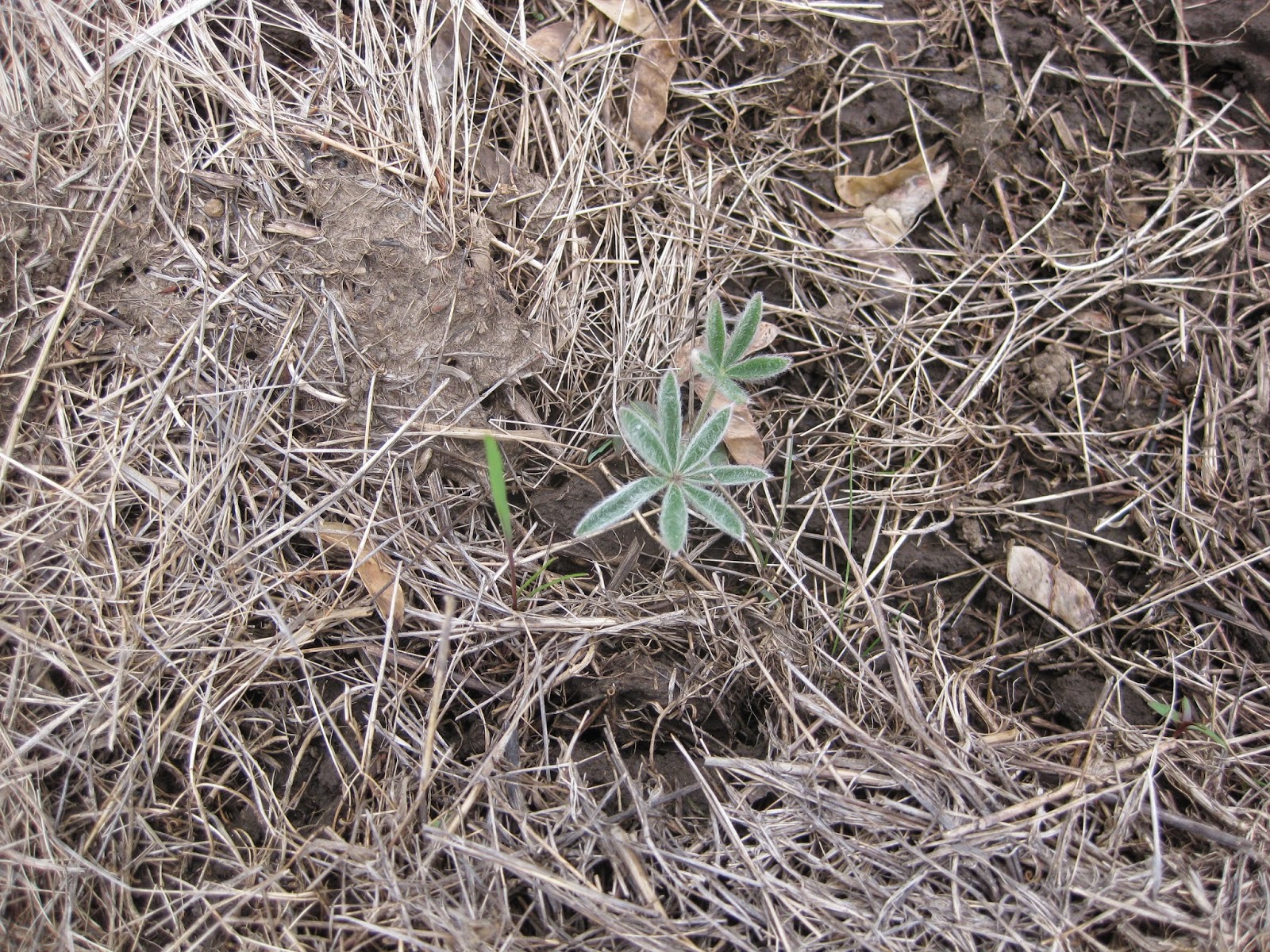
The new project in the south is encouragingly free of weeds and sprouting all sorts of promise.  The method suggested to me by the folks at the Palouse Conservation District and Thorn Creek Seeds (Jacie Jensen) appears to be the way to go (see posts last fall).  In short, you clear an area, and then rake back to expose dirt and plant the seeds on that.  Here is a little Silky lupine and a Lomatium ambiguum sprout from in among those pine trees...


I have been surprised in this area by several patches of Lomatium ambiguum that I didn't plant, as well as a patch of Upland larkspur that I didn't plant.  Today I spotted a larkspur bud there, just about to open...


I think the most stunning bloom at the moment, though, is from a clump of Red besseya.  The biggest clump was chomped by the evil deer (they chomp, but the plant is fine really), but this one escaped their onslaught.


It has been awhile since I have posted a shot from my standard view.  Here is how it looked this afternoon.  Spring!